
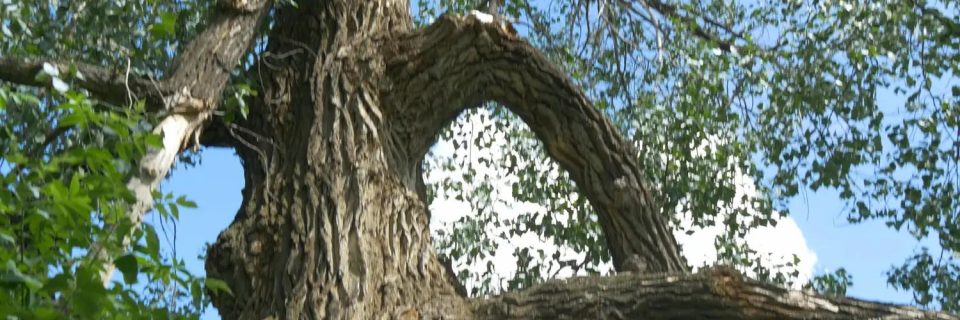
Site #06: The Big Tree
Standing as one of the most recognizable natural landmarks in the Riverlands, the “Big Tree” is more than just a biological marvel; it is a living link to the pre-settlement era. Estimated to be over 160 years old, this massive tree was already a mature landmark when the first pioneers arrived in the district at the end of the 19th century.
A Giant Hybrid
While it is often referred to simply as a cottonwood, the Big Tree is actually a natural hybrid of the Plains Cottonwood (Populus deltoides) and the Balsam Poplar (Populus balsamifera). According to biological surveys cited in Saskatchewan’s Nature Conservancy records, such hybrids are rare in their ability to reach these dimensions. Currently, the tree stands at 21 meters tall, though it was once significantly higher before a lightning strike sheared off its crown. With a girth of 5 meters and a canopy span reaching 32 meters, it remains one of the largest trees of its kind in the province.
Stewardship of the Popoff Family
The survival of the Big Tree is largely credited to the personal stewardship of the Popoff family, particularly Sam Popoff, who owned the land for many years. As noted in the local history book Bridging the Years: Era of Blaine Lake and District 1790-1980, while many giant trees in the region were harvested for homestead lumber or fuel, the Popoffs recognized the tree’s unique character and chose to protect it. Sam Popoff often welcomed visitors and shared stories of the tree’s history, effectively acting as its unofficial curator. This family legacy ensures that the tree remains a point of pride for the local community and a permanent fixture of the Riverlands landscape.
The Laird Ferry Connection
The tree’s location near the historical site of the Laird Ferry made it a vital landmark for travelers. As documented in Saskatchewan Department of Highways ferry records, the Laird crossing was a central lifeline for moving grain and mail across the North Saskatchewan River. The Big Tree served as a natural beacon for those approaching the riverbanks, visible for miles across the relatively low-lying scrub and brush. Its massive canopy provided a recognizable point of reference for decades of ferry operators and homesteaders navigating the river valley.
Witness to History
Because of its extreme age, the tree has witnessed the complete transformation of the Riverlands. It stood during the peak of the fur trade traffic on the river, through the 1885 Resistance, and watched as the communal Doukhobor villages transitioned into modern family farms. As noted in the Saskatchewan Register of Heritage Assets, the preservation of such “Ancient Trees” is critical not just for biodiversity, but as a form of natural heritage that provides a tangible sense of time and scale to the human history of the district.