
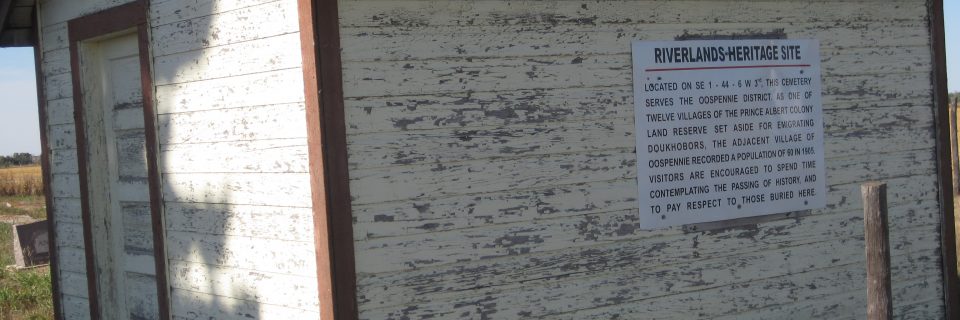
Site #07: Ospennia Cemetery
Located just a short distance from the site of the former Ospennia School, this cemetery is the final physical remains of the village of Ospennia. Founded in 1899, Ospennia was one of twelve villages established within the Prince Albert land reserve specifically for the Doukhobor people. At its height, the village was a thriving communal settlement, characterized by the distinct architecture and social organization the settlers brought from their Russian homelands.
Village Life and Layout
Unlike the independent homesteads typical of Anglo-Saxon settlers, Ospennia followed a traditional “Srtet” or street-village layout. Houses were built closely together along a central road, with barns and communal granaries clustered at the ends. According to the Doukhobor Genealogy Website, this proximity was designed to foster a spirit of community and mutual aid. The cemetery was situated on the outskirts of the residential area, serving as a spiritual boundary for the village residents. As documented in the local history book Bridging the Years: Era of Blaine Lake and District 1790-1980, the village was eventually abandoned after 1907 when the federal government revoked land rights for many communal settlers, forcing families to move onto individual 160-acre quarter-sections.
The Evolution of the Markers
The headstones within Ospennia Cemetery tell a story of cultural adaptation. In the earliest years of the settlement, many graves were marked with simple wooden crosses or small stones, reflecting the Doukhobor belief in the transience of the body and the permanence of the soul. Over time, as noted in the Saskatchewan Register of Heritage Assets, these were replaced by more permanent granite markers inscribed with Cyrillic script. These stones often list only a name and a year of birth and death, adhering to the traditional Doukhobor value of modesty, yet they provide a vital genealogical record for the descendants of the original 1899 migration.
A Protected Legacy
Today, the cemetery is a protected heritage site maintained by local families and volunteers. According to Information Services Corporation (ISC) land title records, the cemetery is officially designated as a non-arable heritage parcel. While the surrounding fields have returned to active agriculture, this plot remains undisturbed, ensuring the resting places of the Ospennia pioneers are preserved as a permanent part of the Riverlands’ landscape.