
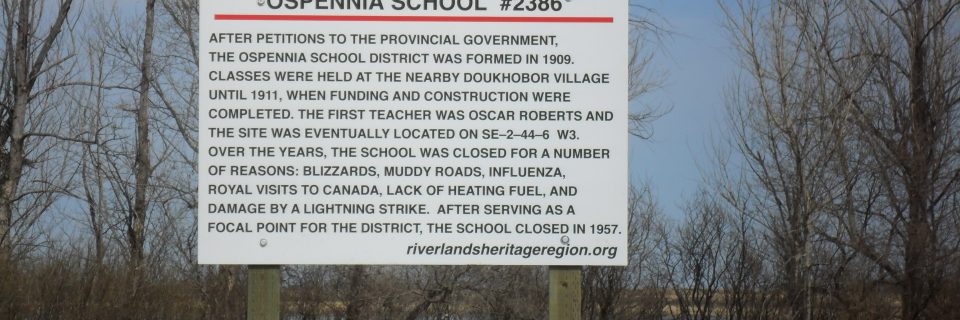
Site #05: Ospennia School (No. 2386)
The Ospennia School district represents a significant milestone in the history of the Riverlands, marking the transition of the local Doukhobor community into the broader Canadian social fabric. Founded in 1909, the school served the families of the nearby Ospennia village, becoming a hub of literacy and cultural exchange for nearly half a century.
The Meaning of Ospennia
Like many surrounding settlements, the village of Ospennia was named by Doukhobor pioneers to honor their roots. According to the Doukhobor Genealogy Website, “Ospennia” (also spelled Uspenie) refers to the “Dormition” or “Assumption,” a term rooted in the Russian Orthodox calendar that the Doukhobors carried with them as a geographic namesake, despite their break from the formal Church. The establishment of a school here was a major step; as noted in the Saskatchewan Department of Education records, the district was only formed after intensive petitioning to the government by local families who sought to ensure their children were prepared for life in a rapidly changing Saskatchewan.
Trial by Lightning
The history of the school building itself is one of resilience. The original structure opened its doors in 1911, but its service was cut short by the unpredictable prairie elements. As documented in the community history Bridging the Years: Era of Blaine Lake and District 1790-1980, the first schoolhouse was struck by lightning and suffered severe damage. Rather than abandon the district, the community rallied to rebuild at a new location (SE–2–44–6 W3). This second schoolhouse became the heart of the district until 1957, hosting not only classes but also community dances, debates, and local meetings.
A Cultural Bridge
For many students at Ospennia, the school was their first sustained contact with the English language and non-Doukhobor traditions. Memoirs cited in the Blaine Lake Museum archives describe the early years where teachers—often young women from Ontario or the Maritimes—lived in small “teacherages” on the school grounds. These educators played a vital role in the “Canadianization” of the district, though they often learned as much from their students about Russian choral singing and communal values as the students learned about British history and mathematics.
Closure and Conservation
By the late 1950s, the era of the one-room schoolhouse was ending as Saskatchewan moved toward school consolidation. When Ospennia School officially closed in 1957, students were bussed into Blaine Lake. Today, the site stands as a quiet tribute to the “University of the Prairies”—the small, isolated buildings that provided the foundation for the region’s professional and agricultural success.