
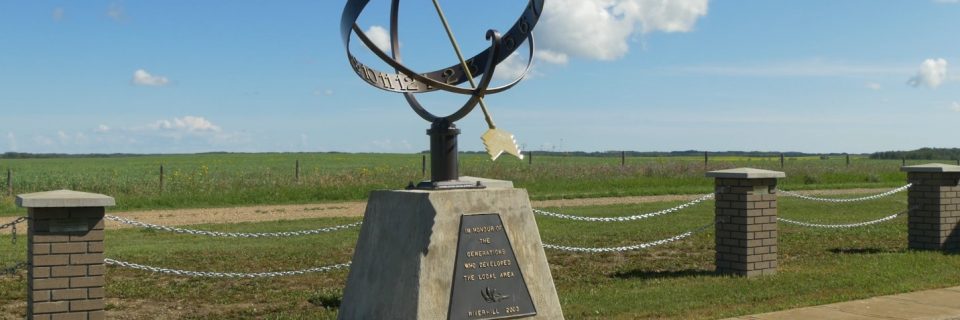
Site #11: Riverhill (Spasovka) Armillary & Cemetery
While the village of Spasovka no longer stands, its memory is anchored by a remarkable celestial monument and a beautifully maintained cemetery. This site marks the location of “Spasovka,” which was the largest and most populous of the Doukhobor villages in the district, once home to 47 households and over 200 residents.
The Meaning of Spasovka
The name “Spasovka” (or Spasskoye) is deeply rooted in Doukhobor spiritual geography. According to the Doukhobor Genealogy Website, it translates roughly to “Place of Salvation” or “Saviour’s Village.” The pioneers brought this name from their former village in the Kars region of the Russian Empire, carrying the hope that this new land in Saskatchewan would finally provide the “salvation” from persecution they had long sought.
The Armillary Monument
Unveiled in 2003, the Riverhill Armillary is a unique heritage marker designed by Maurice Postnikoff and built with the support of local families. Unlike a standard plaque, this monument is a functional scientific instrument—a “spherical sundial” based on Renaissance-era designs.
- The Geometry: The monument is precision-calibrated to the local latitude of 53° N.
- The Gnomon: An arrow (the gnomon) points directly toward Polaris (the North Star), the same celestial beacon used by early travelers on the Fort Carlton Trail.
- Real Time: On a sunny day, the gnomon casts a shadow onto the numbered horizon ring, indicating “solar time.”
As noted in the Riverlands Heritage Region Brochure, the armillary was chosen specifically to represent the pioneering spirit—honoring those who navigated by the stars to build a future on the plains.
Riverhill (Spasovka) Cemetery
The cemetery remains an active focal point for the district. Established in 1916 on Riverlot 8-45-5 W3, it holds approximately 120 interments. According to transcriptions by Jonathan J. Kalmakoff, many of the earliest graves were unmarked or marked with simple concrete posts, but the site has since been revitalized with a wrought iron gate and a brick-and-chain fence. Unlike the communal village cemeteries that were often abandoned, Riverhill continues to be a place of pride. Visitors are encouraged to sign the guest book located on-site, a tradition that connects modern travelers with the descendants of the original 1899 settlers who continue to care for this “hill of salvation.”