
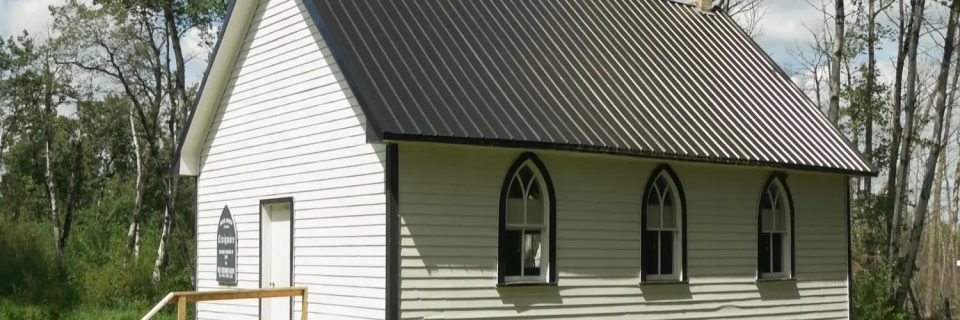
Site #14: Craigmore Church and Cemetery
Set against a backdrop of rolling hills and aspen bluffs, Craigmore Church is often cited as one of the most serene and idyllic locations in the province. More than just a place of worship, it serves as a monument to the intellectual and spiritual leadership of the region’s early British-isles settlers.
The Vision of Dr. Benjamin Ralph
The history of Craigmore is inextricably linked to Dr. Benjamin Ralph, an Irish-born educator and clergyman who arrived in the district in 1904. Named after a college in Ireland where Dr. Ralph had taught, “Craigmore” was founded as a center for both community worship and intellectual guidance. According to the Saskatchewan Archives Board memoirs, Dr. Ralph was a man of immense learning who chose the rigors of homesteading over a comfortable life in Europe. He served the district with distinction until his death in 1930, and his grave remains a focal point of the cemetery.
Architecture and Atmosphere
The church building itself is a classic example of early prairie ecclesiastical architecture. Its simple, clean lines and modest bell tower were designed to withstand the harsh Saskatchewan winters while providing a welcoming space for the Presbyterian (and later United Church) congregation. As noted in the local history book Bridging the Years: Era of Blaine Lake and District 1790-1980, the church was built through the donated labor and funds of the local pioneers, who viewed the construction of a permanent “House of God” as a sign that they had finally successfully settled the land.
A Place of Serenity
The Craigmore Cemetery, which surrounds the church, is noted for its peaceful atmosphere. Unlike the large, municipal cemeteries of the towns, Craigmore remains a “country” churchyard, where the wind through the poplars is often the only sound. As documented in the Saskatchewan Register of Heritage Assets, the site is carefully preserved to maintain its original 1904 character, offering a tangible sense of the “quiet strength” that defined the settler experience in the Riverlands.