
Site #15: Carlton Crossing
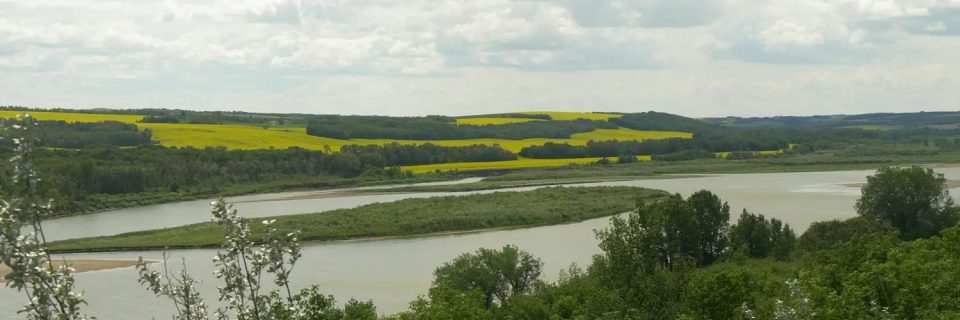
This vantage point offers one of the most significant historical panoramas in Western Canada. Standing high on the west bank of the North Saskatchewan River, you are looking out over a natural funnel that has drawn travelers, hunters, and soldiers to this specific spot for thousands of years.
The Strategic Gateway
For millennia, this was a traditional crossing point for Indigenous hunters following the buffalo. When the fur trade expanded, the Hudson’s Bay Company (HBC) recognized the site’s importance, establishing Fort Carlton directly across the river. As documented in the Hudson’s Bay Company Archives, the Fort served as a “provisions post,” where bison meat was converted into pemmican to fuel the canoe brigades heading into the far north.
The North-West Resistance (1885)
Carlton Crossing was a focal point during the 1885 Resistance. Because it was the main supply link for the North-West Mounted Police (NWMP), controlling this crossing was a high priority for the Métis forces led by Gabriel Dumont. According to accounts in Bridging the Years, the NWMP were forced to abandon and accidentally burn the Fort in March 1885, using this very crossing to retreat toward Prince Albert.
A Witness to Treaty Six
Perhaps the most lasting legacy of this site occurred in August 1876. On the flats across the river, representatives of the Crown and the Plains and Wood Cree met to negotiate Treaty Six. As noted by the Office of the Treaty Commissioner, this location was chosen because it was a neutral, well-known gathering place. The negotiations held here marked the fundamental transition from the era of the fur trade to the era of settlement.
The Modern View
Today, the river flows much as it did in the 1800s, though the bustling trade hub has been replaced by the quiet of Fort Carlton Provincial Park. Looking across, you can see the partially reconstructed palisades of the Fort, standing as a silent reminder of the days when this crossing was the busiest “highway intersection” in the West.