
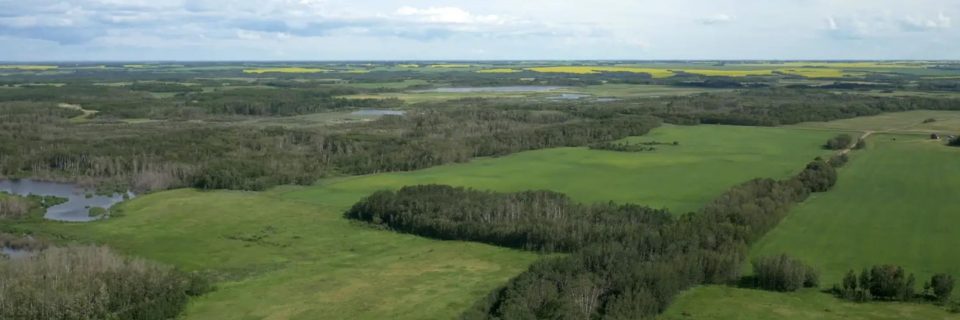
Site #21: Fort Carlton – Green Lake Trail (North)
If Site #13 was the “entrance” to the trail, Site #21 is the place to witness its sheer scale. Here, the trail isn’t just a story; it is a physical part of the earth. In certain lights, you can still see the multiple, side-by-side tracks left by brigades that once stretched for miles across the landscape.
The “Screeching” Brigades
By the 1860s, this section of the trail was a bustling commercial corridor. As documented in the Encyclopedia of Saskatchewan, cart brigades often traveled “twenty abreast” on open sections to avoid deep mud. The most famous feature of these trips was the noise. Because the Red River Carts were made entirely of wood and could not be greased, they produced a high-pitched, rhythmic “screech” that could be heard for miles across the parkland.
Ingenuity of the Red River Cart
The cart itself was a masterpiece of Métis engineering. Built without a single piece of metal, it was lashed together with “shaganappi” (green buffalo hide) that tightened like steel as it dried. According to the Indigenous Peoples Atlas of Canada, these carts were even amphibious; when a brigade reached a river, they would remove the wheels and wrap the box in buffalo hides to create a raft.
The Life of the “Carter”
The men who drove these carts were the professional truckers of their day. As noted in Bridging the Years, these brigades hauled everything from pemmican and furs heading east to “outfit” supplies like flour, sugar, and tea heading west. Walking along the ruts today, you are following the exact path where thousands of tons of cargo were once hauled by hand and hoof to build the foundations of Western Canada.