
Site #17: Local Fauna (Animals and Birds)
The Riverlands is a biological “crossroads.” The transition from the North Saskatchewan River valley to the upland parkland creates a diverse range of micro-habitats, supporting a surprising variety of wildlife—from tiny shrews to elusive apex predators.
The Mammals of the Riverlands
Within this region, over 50 species of mammals have been documented. The river valley acts as a natural highway for larger animals moving between the northern forests and the southern plains.
- Large Mammals: Mule Deer and White-tailed Deer are common, while Moose and Elk frequent the thicker cover. Predators such as the Coyote, Red Fox, and occasionally Black Bears are also present.
- The Rare Sightings: According to records from the Saskatchewan Ministry of Environment, the rugged coulees provide habitat for the Lynx and the occasional Cougar.
The Stars of the Flyway: Whooping Cranes
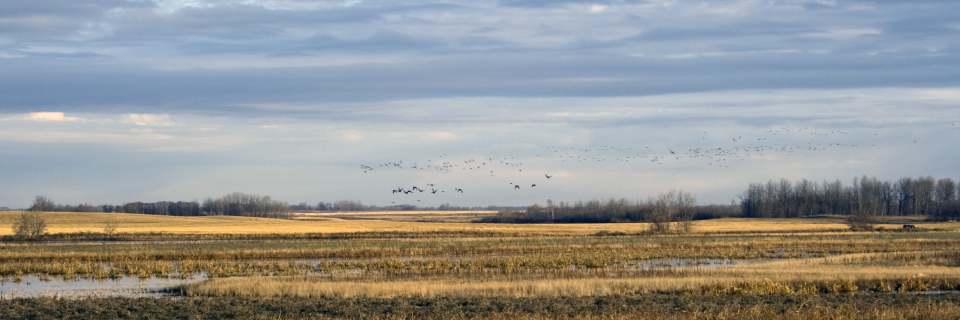
The Riverlands holds a special distinction as a critical “staging area” for the endangered Whooping Crane. According to naturalist Trevor Herriot, this region is part of the “ancient homeland” for these birds, which once nested throughout southern Saskatchewan. Today, they use the wetlands near Marcelin and Blaine Lake as their primary stopover during fall migration.
Standing nearly 1.5 meters tall, these majestic white birds are often seen in stubble fields alongside Sandhill Cranes. As documented by the Canadian Wildlife Service, it is not uncommon to see a significant percentage of the world’s wild population resting in the Riverlands during October, refueling for their long flight to the Gulf of Mexico.
An Avian Paradise
The Riverlands is a premier destination for birdwatchers, with over 200 species sighted annually. As documented in the Saskatchewan Breeding Bird Atlas, the region serves as a critical stopover for migratory songbirds and nesting grounds for birds of prey like the Red-tailed Hawk and the Great Horned Owl.
Coexistence with Agriculture
Wildlife in the Riverlands has adapted to the agricultural landscape. As documented in Bridging the Years, early settlers had a complex relationship with local fauna. Today, many local producers help maintain biodiversity by preserving shelterbelts and natural bluffs, ensuring that the Riverlands remains a shared home.